
The Golden Thread in Practice
Getting Your Passive Fire Documentation Right
The term “golden thread” has become one of the most talked about concepts in building safety since the Hackitt Review and the subsequent Building Safety Act 2022. Yet for many dutyholders, responsible persons and building owners, the practical reality of what it demands (especially around passive fire protection) still raises questions.
Here, we break down what the golden thread means for passive fire documentation, why it matters and what good practice looks like.

What is The Golden Thread?
The golden thread is a continuous, structured record of information about a building — who made decisions, what was installed, why and when. The principle is straightforward: if a building’s fire strategy is going to protect people effectively, everyone responsible for maintaining it needs accurate, accessible information.
For passive fire protection, this is particularly significant. Unlike active systems such as sprinklers or alarms, passive measures (fire doors, fire stopping, penetration seals) are largely hidden once a building is complete. Without solid documentation, there is no reliable way to verify that they are present, correct or performing as intended.
Get Your Passive Fire Survey TodayWhat Documentation Should You Hold?
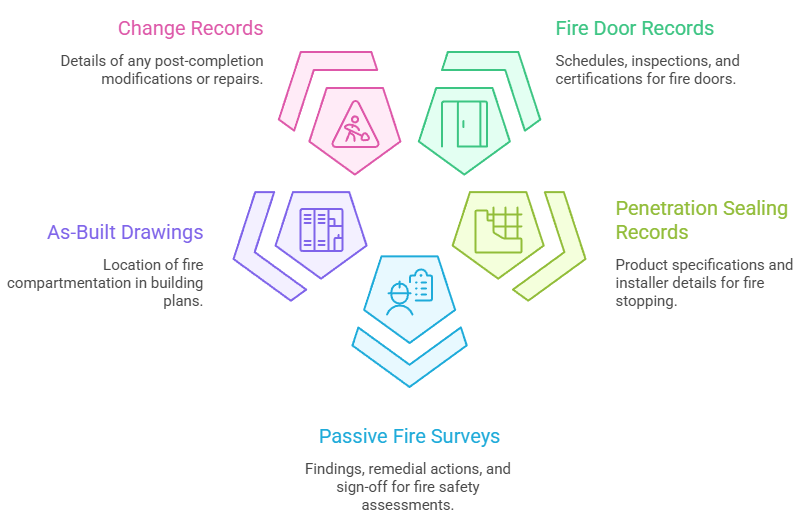
Getting the golden thread right for passive fire means maintaining clear, consistent records across the life of the building. At a minimum, this should include:
- Fire door schedules, inspection records and certification
- Penetration sealing and fire stopping records, including product specifications and installer details
- Passive fire surveys, with findings, remedial actions and sign-off
- As-built drawings showing the location of fire compartmentation
- Details of any changes or remedial works carried out post-completion
These records need to be kept up to date, not filed away after a one-off survey and forgotten.
Why Accuracy Matters More Than Volume
One common mistake is treating documentation as a box-ticking exercise. A thick folder of paperwork is only useful if the information inside it is accurate, traceable and actually reflects what is in the building.
This is where the quality of the original installation and inspection work becomes critical. Records created by FIRAS-accredited contractors, for example, carry a level of credibility and technical rigour that generic records cannot match. Accreditation means that the work has been carried out and recorded to a recognised industry standard.
Keeping Records Current
The golden thread is not a one-time task. Buildings change, tenants move in and out, services are re-routed, walls are altered. Every time passive fire protection is disturbed or reinstated, that activity needs to be recorded and added to the thread.
Scheduling regular passive fire surveys is one of the most effective ways to keep documentation current and identify any gaps before they become compliance issues.
How BSML Can Help
At BSML, we provide FIRAS-accredited fire stopping, penetration sealing, fire door installation and maintenance and passive fire surveys. Every piece of work we carry out comes with clear, detailed documentation that slots directly into your golden thread records, giving you confidence that your building’s passive fire strategy is both compliant and properly documented.
Talk to our team to book a passive fire survey today.
The information provided in this article is for general guidance only and is not legal or professional advice.